
Best Flooring and Wall Finishing Contractors in Bahrain
Handyman Services installs commercial flooring and wall finishes across retail, office and hospitality projects in Bahrain. Clients looking for tile flooring contractors bahrain usually discover that the finish is the easy part — what determines whether a floor lasts is the substrate beneath it, the movement joints designed into it, and whether the material was ever suitable for the traffic it now carries.
The scope, itemised.
- Marble, granite and natural stone flooring and cladding
- Porcelain and ceramic tiling, large format and standard
- Epoxy, polyurethane and resin flooring for commercial kitchens and industrial areas
- Raised access flooring systems
- Vinyl, LVT and commercial carpet
- Micro-cement, polished concrete and seamless finishes
- Venetian plaster, decorative and specialist wall finishes
- Fabric panelling and acoustic wall cladding
- Stone cladding, feature walls and wall panelling
- Commercial wallpaper, painting and decorative finishing
The substrate decides the outcome
Almost every flooring failure we are asked to investigate traces back to what was underneath rather than what was laid on top. A screed that was not flat produces lipping between large-format tiles. A substrate that was not dry traps moisture beneath an impermeable finish. Movement joints omitted because they interrupt the pattern lead to cracking within a year. None of these are visible at handover and all of them are expensive afterwards, so we survey levels, test where moisture is a risk, and set out movement joints as part of the design rather than as an afterthought.
- Levels surveyed and substrates corrected before any finish is laid
- Moisture testing where an impermeable finish is specified
- Movement joints designed into the setting out
- Primers and adhesives matched to substrate and finish
Choosing a finish for the traffic it will take
Commercial flooring is a duty specification before it is an aesthetic one. A polished marble that looks superb in a showroom will not survive a mall entrance, and a kitchen floor needs slip resistance under wet and greasy conditions rather than a slip rating measured dry. Epoxy and resin systems suit commercial kitchens and back-of-house because they are seamless, coved to the wall and cleanable. Raised access flooring suits offices where services distribution matters more than floor build-up. We specify against the actual conditions and say so when a client's preferred material is not appropriate for the location.
- Slip resistance specified for wet and greasy conditions, not dry
- Seamless coved resin systems for food preparation areas
- Raised access flooring where services distribution governs
- Material durability matched to real footfall
Stone, marble and large-format work
Natural stone carries variation between slabs, which is a virtue when it is planned for and a defect when it is not. Slabs should be selected and dry laid so that the sequence of veining is deliberate rather than arbitrary, and cutting should be planned around the setting out so that a feature wall does not end on a 30mm sliver. Large-format porcelain has its own demands — full bed adhesive coverage, careful handling, and levelling systems during installation, because a lipped edge on a 1200mm tile is visible from the other end of a room.
- Slab selection and dry laying before fixing
- Setting out planned to avoid awkward cuts at edges and features
- Full adhesive coverage and levelling systems for large format
- Sealing and protection appropriate to the stone and its exposure
Decorative and specialist wall finishes
Wall finishes beyond paint — micro-cement, Venetian plaster, fabric panelling, acoustic cladding, stone and timber feature walls — are applied finishes whose quality depends almost entirely on preparation and on the applicator. They are also frequently the element a client remembers, because they sit at eye level in the areas customers occupy. We delivered large-scale artistic wall painting for Muharraq Nights, and specialist finishes across our restaurant and retail portfolio.
- Micro-cement, polished plaster and seamless applied finishes
- Fabric panelling and acoustic wall cladding
- Stone, timber and metal feature walls
- Decorative painting, wallpaper and specialist applications
Delivered, not illustrated.

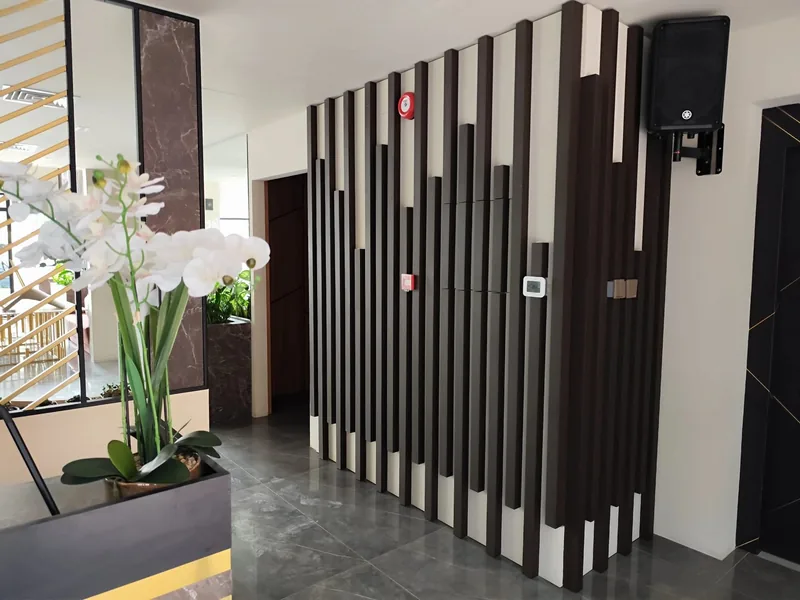
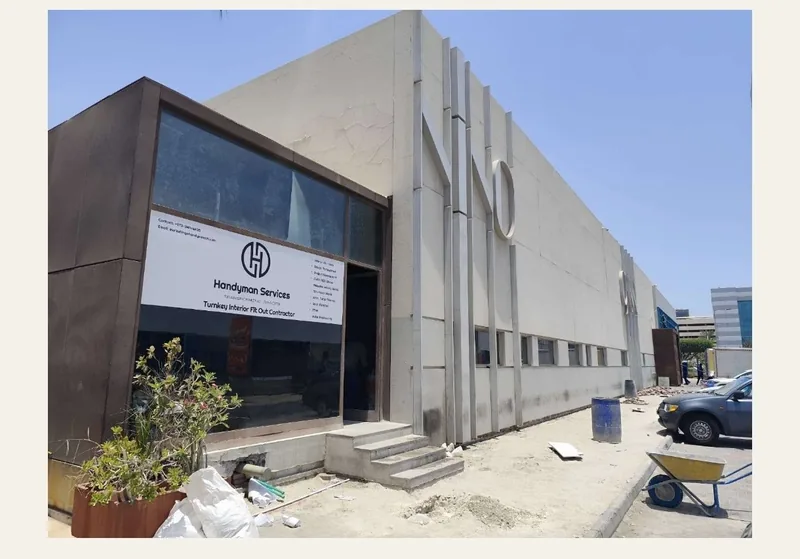
Flooring and wall finishes formed part of the scope across the retail and food and beverage portfolio, including the Ajmal Perfumes stores, Amal Al Majed Jewellery and Zooba.
What clients ask us first.
What flooring is suitable for a commercial kitchen?
A seamless resin or epoxy system, coved up to the wall so there is no junction to trap water or debris, with slip resistance rated for wet and greasy conditions rather than dry. Tiled kitchen floors are permitted but the grout lines are a cleaning and hygiene liability, and health inspection will look at exactly that detail.
Why do tiles crack or lift after a few months?
Almost always the substrate or the movement joints. A screed that was not flat, not dry or not properly bonded will fail regardless of the tile laid on it, and omitting movement joints because they interrupt the pattern causes cracking as the structure moves. Both are decided before the first tile is set, which is why we survey and test rather than assume.
Can you install raised access flooring?
Yes. It is the usual choice for offices where power and data distribution matters, and it needs the slab level surveyed first because the pedestal system has a limited adjustment range. It also affects door thresholds and finished ceiling height, so it should be settled early in the design rather than added later.
Do you supply marble and stone as well as install it?
Yes. Where the design depends on the character of the material, we recommend slab selection and dry laying before fixing so that the veining sequence is deliberate. Natural stone varies between slabs, which is either a feature or a complaint depending on whether it was planned.
What is micro-cement and where does it suit?
A thin polymer-modified cementitious coating that produces a seamless surface over floors and walls, without the joints of tile. It suits retail and hospitality interiors where a continuous finish is wanted. It is highly dependent on substrate preparation and on the applicator, so it is not a finish to award on price alone.
Need this on your project?
Send us the drawings and the handover date and we will come back with a programme and a price.