
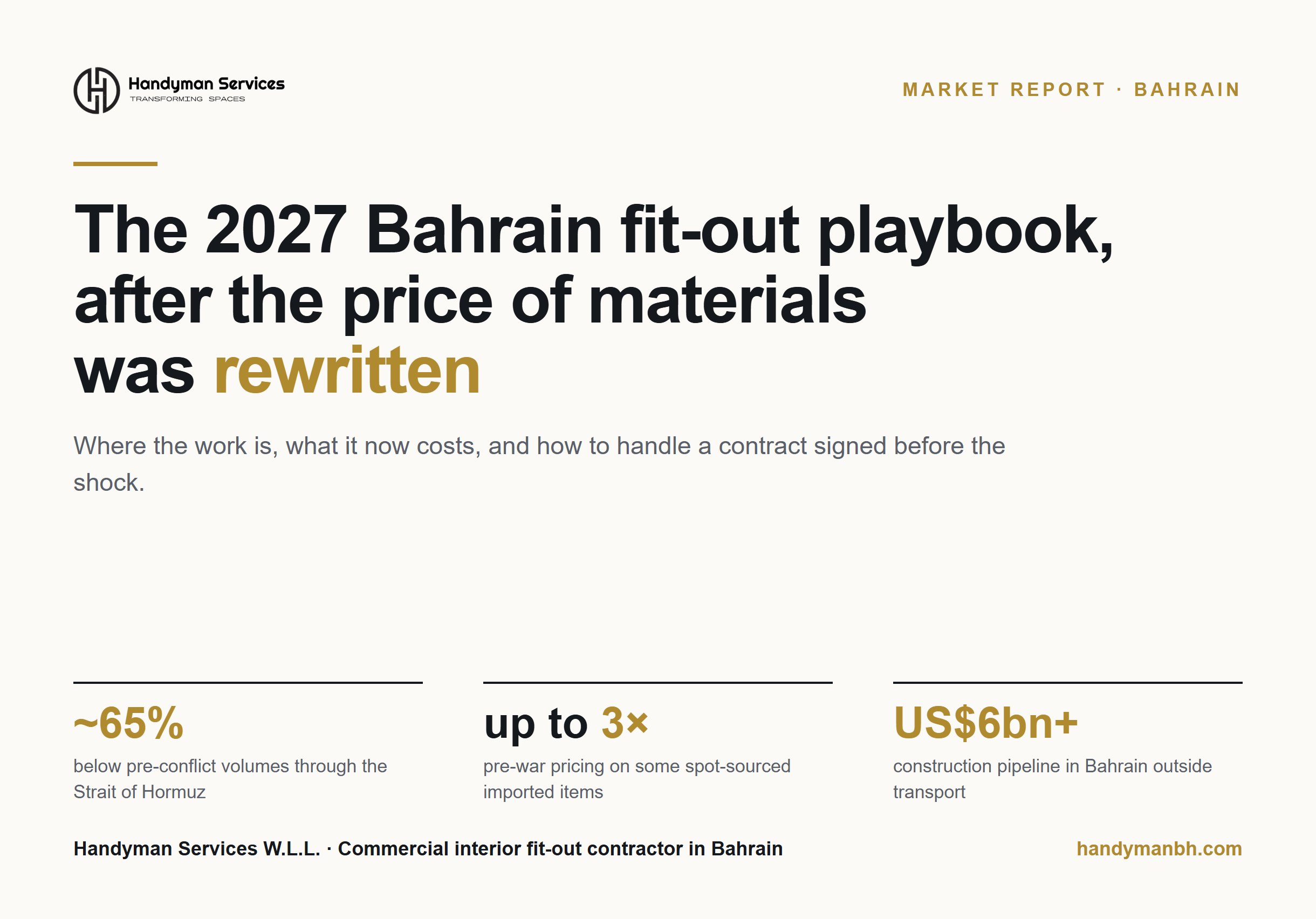
If you are planning an office, restaurant, cafe, retail or F&B fit-out in Bahrain for 2027, the ground has moved under your budget. Since 28 February 2026, when the US-Israeli strikes on Iran began and shipping through the Strait of Hormuz was disrupted, the cost of getting materials into the Gulf has changed more in a few months than it did in the previous decade.
At Handyman Services we have delivered commercial interior fit-outs across Bahrain's malls and commercial spaces for more than ten years. We have priced, procured and built through shocks before, but nothing like this. This guide is our honest read of the market for GCC and Bahrain interior fit-out in 2027: where clients are, where the risks and opportunities sit, how to deal with contracts signed before the war, and what a sensible strategy looks like for both sides of the table.
The short answer: Bahrain fit-out in 2027
- Demand is not gone, it is changing shape. Clients are favouring refurbishments, phased openings, community-focused retail and F&B, and quality office space over large speculative new builds.
- Material cost and delivery risk is the number one threat. Imported aluminium, PVC-based products, paints, glass, MEP items and joinery hardware have been hit hardest, and some spot-sourced items have been quoted at up to roughly three times pre-war levels.
- Pre-war fixed-price contracts need an honest conversation. The fairest outcomes come from documented evidence, shared-risk mechanisms and early value engineering, not from silence or disputes.
- The winners in 2027 will be resilient, transparent contractors. Those with strong supplier networks and local and land-route sourcing, and clients who decide early, procure early and choose partners on certainty rather than the lowest bid.
Where the Bahrain fit-out market stands after the war
It is important to be precise about post-war. A ceasefire was announced on 8 April 2026, yet commercial shipping through the Strait of Hormuz has remained well below pre-war levels. As of early November 2026, regional reporting put Hormuz traffic roughly 65 per cent below pre-conflict volumes, negotiations were continuing through mediators, and attacks on vessels had not fully stopped. For planning purposes, Bahrain's commercial sector is operating in a post-shock, pre-settlement environment, and 2027 budgets should assume that logistics will normalise gradually rather than overnight.
Bahrain felt the conflict directly. Attacks hit targets on the island, including critical infrastructure, and the national aluminium smelter, Alba, partially shut down in March and has been operating below capacity. Bahrain's transport minister has said the kingdom leaned more heavily on road transport and alternative ports in neighbouring Gulf countries once shipping became constrained.
MEED reported on 5 November 2026 that Bahrain's construction and infrastructure sector remains subdued: contract awards edged up this year after a sharp contraction in 2025, but volumes are still far below historical benchmarks. Bahrain's Tender Board said 1,357 tenders and auctions worth about US$2.82 billion were awarded in the first nine months of 2026, with construction and engineering consultancy accounting for about US$711 million. Outside transport, the construction pipeline still exceeds US$6 billion, led by the Bahrain International Sports City in Sakhir.
At the Gateway Gulf event in early November, Bahrain approved four Golden Licence projects worth US$3.89 billion across aviation, real estate and technology. On the retail side, CBRE's H1 2026 snapshot put occupancy across its tracked Bahrain retail assets at around 65 per cent, with average Grade A and B rents stable at about BD5.1 per sqm per month and no significant additions to the development pipeline.
How commercial clients are behaving
| Client behaviour | What it means for fit-out |
|---|---|
| Phasing and deferral | Larger roll-outs are being split into phases or paused until pricing and shipping stabilise. Brands are opening fewer sites, but opening them properly. |
| Refurbish before you build | Refreshing existing units, renewing leases and upgrading tired interiors is preferred to new-build capital commitments. Refurbishment and re-fit scopes are the steadier work stream. |
| Local demand over tourist demand | Community and neighbourhood formats are holding up better than tourist-dependent destination retail. Convenience F&B and cafes fit that pattern. |
| Demand for price certainty | Clients ask for shorter quote validity, firmer procurement schedules, fixed-price packages for long-lead items and full transparency on imported content. |
| Quality over quantity in offices | Companies committing to space want Grade A quality, flexible layouts and semi-fitted CAT A and CAT B solutions that reduce upfront cost and time. |
| Contractor resilience as a selection criterion | Financial strength, supplier relationships, local manufacturing capability and a track record in Bahrain's malls weigh more heavily than they did a year ago. |
Why materials became the central risk
The Strait of Hormuz carries around a fifth of the world's oil and large volumes of LNG, petrochemicals and industrial inputs, and the Gulf imports most of its fit-out materials by sea. When the strait closed to normal traffic, three cost layers rose together: freight and rerouting, war-risk insurance, with reports at the time pointing to increases of up to 50 per cent on cover for Hormuz-transiting vessels, and energy and petrochemical feedstock costs. Brent crude swung between roughly US$70 and US$118 during 2026.
International benchmarks show how this feeds into interiors. Aluminium reached a four-year high after attacks on smelters in Qatar and Bahrain. PVC prices rose by more than 30 per cent in some markets. Paint and coating manufacturers raised prices, and windows and doors producers issued increases. Aluminium, glass, PVC, paints, adhesives, sealants, lighting, HVAC components, cable and joinery hardware all sit inside a typical commercial fit-out.
Published indices generally show category-level increases in the tens of per cent. On the ground, contractors in Bahrain, ourselves included, have seen individual imported items and spot-sourced materials quoted at up to roughly three times pre-war levels, especially where stock was scarce, brands were single-source or goods were being rerouted through neighbouring ports. That gap between the average and the worst case is exactly where uninformed budgets get hurt.
Opportunities and threats in 2027
| Opportunities | Threats |
|---|---|
| Refurbishment and re-fit wave: landlords and tenants renewing existing mall units, offices and restaurants rather than building new. | Material price volatility: imported items can be re-quoted or unavailable between tender and procurement. |
| Government-backed pipeline: Sports City, Golden Licence projects, Digital City, hospitality and mixed-use developments. | Cash-flow squeeze: rising procurement costs paid before clients pay, with delayed approvals and payments. |
| Local sourcing and regional supply: demand for contractors with in-kingdom joinery, metal, glass and gypsum capability and road links to Saudi Arabia. | Contract disputes: fixed-price agreements signed before March 2026 now carry unbalanced risk. |
| Community retail and F&B formats: cafes, quick-service, convenience and neighbourhood retail built for resident demand. | Low-ball tendering: underpriced bids that cannot be delivered, leading to stalled sites and reputational damage for the whole market. |
| Design-and-build and turnkey: clients prefer a single accountable partner to control cost, time and quality. | Programme risk: long lead times, port congestion and security-related disruptions to shipping and insurance. |
| Flight to quality in offices: Grade A, flexible, tech-ready and wellbeing-focused workplaces. | Soft demand in tourist-reliant locations: luxury retail, high-end dining and hospitality exposed to travel disruption. |
A practical playbook for contractors
- Shorten and condition every quotation. Use short price-validity windows, days rather than months, for imported items, list the specific brands and origins priced, and state the assumptions behind each line.
- Build price-adjustment mechanisms into new tenders. Index-linked adjustment for named high-volatility items such as aluminium, glass, PVC, paint and copper cable, or a clear threshold above which risk is shared.
- Procure early and in tranches. Order long-lead and volatile items at contract award, with client-approved advance payments or direct payment to suppliers, and release the rest in stages.
- Diversify suppliers and routes. Qualify two or three suppliers per critical item, including local and GCC manufacturers and goods arriving by road through Saudi Arabia, rather than relying on a single sea route.
- Localise where quality allows. In-kingdom joinery, metalwork, gypsum, glass processing and stone fabrication reduce exposure to freight and insurance shocks and shorten programmes.
- Standardise and pre-fabricate. Repeatable details, modular joinery and off-site fabrication cut waste, reduce site time and make costs easier to lock.
- Value-engineer from day one. Offer pre-approved alternatives that protect the design intent while reducing imported content.
- Document everything. Keep dated supplier quotations, invoices, shipping notices and correspondence. Evidence is the foundation of any fair cost recovery.
- Protect cash flow. Negotiate milestone payments tied to material delivery, avoid carrying large unfunded stock, and keep credit lines healthy.
- Be honest about what you can deliver. Walk away from, or re-scope, work that cannot be delivered at the price offered. A transparent no protects both sides.
Contracts signed before March 2026
Projects signed off before the war were priced on a world that no longer exists. Many are fixed-price lump sums with long procurement windows. Without a fair process, both sides lose: contractors absorb losses and slow down, clients face delays, claims or abandoned sites. Our view is simple. Engage early, share the evidence and share the risk in a structured way.
This is general industry guidance, not legal advice. The right outcome depends on your contract wording and Bahraini law. Take advice from a qualified construction lawyer before issuing notices or agreeing variations.
- Read the contract first. Check for price adjustment or fluctuation clauses, provisional sums for materials, force majeure and hardship provisions and their notice deadlines, the extension-of-time and variation procedures, and who bears the risk of imported items and delivery delay.
- What contractors should do. Give timely written notice as the contract requires, present a transparent cost-impact file with original and revised quotations, invoices and shipping documents, offer a menu of mitigation options, and keep working where safe and practical.
- What clients should do. Treat it as a joint problem. A contractor bankrupted mid-project is the most expensive outcome for any owner. Ask for evidence rather than assertions, consider approved alternatives before agreeing increases, and explore direct purchasing of volatile materials.
| Fair-sharing model | How it works | Best used when |
|---|---|---|
| Documented pass-through | Only the verified, documented increase on named materials is adjusted, with an agreed handling margin. | Material content is high and supplier evidence is strong. |
| Shared-risk band | The contractor absorbs the first agreed percentage; the client and contractor share the next band; extreme spikes are re-priced. | Both parties want predictability and a clear cap on exposure. |
| Index-linked adjustment | Prices for key items move with an agreed published index or a basket of supplier quotes at set dates. | Programmes are long and items are commodity-driven. |
| Substitution and re-scope | Equivalent materials, local alternatives or simplified details reduce imported content and cost. | Design intent can be preserved with a different specification. |
| Direct client procurement | The client buys long-lead items directly and issues them to the contractor. | The client has stronger credit or supplier relationships. |
| Programme relief | Extension of time for delays caused by logistics disruption, with or without cost compensation as agreed. | Delay, not price, is the main impact. |
Whatever model you choose, record it in a signed variation or addendum. A handshake agreement during a crisis rarely survives the final account.
Strategy for clients planning a 2027 fit-out
- Decide the design early. Late changes are the most expensive risk in a volatile market. Freeze scope and finishes before procurement starts.
- Bring your contractor in early. Two-stage tendering lets the contractor flag material risks, propose alternatives and secure supply while prices are still known.
- Choose the partner, not just the price. Compare bids like for like. A suspiciously low price in 2027 usually hides unpriced risk.
- Budget a realistic contingency. Add a specific allowance for materials volatility and programme risk rather than a generic percentage.
- Pre-order long-lead and imported items. Joinery hardware, specialist lighting, bespoke fixtures, kitchen equipment and shopfront elements should be locked first.
- Use CAT A, CAT B and phased strategies. Fit out the essential areas first and expand once prices and demand are clearer.
- Design for local supply. Specify materials that can be fabricated or sourced in Bahrain or the GCC, and accept approved equivalents.
- Negotiate landlord support. In a soft retail and hospitality environment, fit-out contributions, rent-free periods and turnover-linked terms are on the table.
Strategy for fit-out contractors
- Compete on certainty. Offer transparent open-book pricing for volatile items, firm schedules and honest risk registers.
- Invest in supplier relationships. Preferred-supplier agreements, volume commitments and regional alternatives are now competitive assets.
- Build local and regional capability. Work with established workshop partners for joinery, metal, glass and gypsum, and develop reliable routes via Saudi ports and the causeway.
- Specialise where demand is resilient. Refurbishments, convenience F&B, cafes, community retail, quality offices and projects linked to government-backed programmes.
- Offer design-and-build with value engineering. One accountable team that designs, prices, procures and builds reduces risk for the client.
- Strengthen compliance and safety. Large and government-linked clients prequalify on safety, financial standing and delivery record.
- Invest in people. Skilled supervisors, estimators and project managers are the scarcest resource when every job is a procurement challenge.
Where the demand is, by sector
| Sector | 2027 outlook in Bahrain | Fit-out focus |
|---|---|---|
| Offices | Flight to quality and flexible space; relocations to better buildings; technology and digital companies supported by Golden Licence and Digital City activity. | CAT A and CAT B, acoustic ceilings, partitions, flexible layouts, wellbeing and tech-ready design. |
| Restaurants and cafes | Resident-driven demand is steadier than tourist-driven demand; convenience and quick-service formats favoured; high-end dining more exposed. | Efficient kitchens, durable finishes, modular joinery, fast programmes to reduce lost trading days. |
| Retail and fashion | Community and neighbourhood retail more resilient; destination malls recovering after an initial drop in footfall. | Brand-compliant shopfronts, flexible fixtures, quick refits and refresh programmes. |
| Malls and F&B hubs | Landlords hold occupancy and rents steady; tenant refurbishments and renovations remain active. | Out-of-hours working, strict mall approvals and logistics expertise. |
| Hospitality and mixed-use | Government-backed projects and new brands entering, though travel disruption weighs on near-term hotel performance. | Phased delivery, FF&E procurement strategy, specialist finishes. |
A realistic 2027 outlook
No one can honestly forecast the exact date shipping through Hormuz returns to normal. Three scenarios are worth planning for: normalisation, where freight and insurance fall gradually and prices ease but do not return to pre-war levels quickly; a prolonged standoff, where current conditions persist and price volatility continues; and renewed escalation, bringing new disruption and another price shock. Contracts, budgets and procurement plans that work under all three are the ones that will survive. The fit-out market in Bahrain will reward the clients and contractors who plan for volatility rather than hope it away.
Handyman Services delivers offices, restaurants, cafes, F&B outlets, retail and fashion interiors across Bahrain through design-and-build, turnkey and contracting services, with transparent pricing and early material-risk planning. If you are budgeting a fit-out for 2027, send us the drawings and we will come back with a programme that has the procurement risk built into it. Email marketing@handymanbh.com, or see handymanbh.com.
Market and conflict information in this article was compiled in November 2026 from public reporting, including MEED, Arab News, The National, CBRE, Dezeen, Construction Week Online and Gulf News, and will continue to change. Please verify current conditions before making commercial decisions.