
Best Commercial Office Fit-Out Contractors in Bahrain
Handyman Services is a commercial interior fit-out contracting company based in Bahrain. Businesses looking for commercial fit out contractors usually want one accountable party to take a shell or a tired floor and hand back a working office on a fixed date. That is the whole of what we do: design coordination, authority approvals, construction, MEP, joinery and handover under a single contract.
The scope, itemised.
- Category A fit-out — raised floors, suspended ceilings, base building services and finishes to landlord specification
- Category B fit-out — full occupier fit-out to the tenant's brand, layout and technical brief
- Shell and core completion for new commercial buildings
- Refurbishment and reconfiguration of occupied floors, phased around trading hours
- Gypsum partitioning, acoustic separation and suspended ceiling systems
- Electrical, HVAC, fire fighting, ELV and structured cabling installation
- Bespoke joinery — reception desks, storage walls, meeting room tables and boardroom furniture
- Flooring, wall finishes, glazed partitioning and manifestation
- Furniture supply, installation and final commissioning
- Authority submissions, snagging, handover documentation and defects liability
Category A and Category B fit-out
Most commercial leases in Bahrain hand over a floor at either shell and core or Category A condition, and the distinction changes the contract entirely. A Category A scope brings the space to a lettable standard — floors, ceilings, base services, blank walls. Category B is the occupier's fit-out: layout, brand, meeting rooms, technology, furniture, everything a company recognises as its own office. We deliver both, and we regularly deliver them in sequence for the same building, which removes the coordination gap where a Category B contractor inherits a Category A installation they had no part in specifying.
- Landlord and base building coordination before any work starts on site
- Layout planning against actual headcount, not the drawing's assumed density
- Services capacity checked against the occupier's real load before commitment
- One programme covering both stages where a client holds both scopes
Working in occupied offices
Refurbishing a floor a company is still working on is a different discipline from building an empty one. The constraints are noise, dust, fire escape routes, live services and the fact that people have to do their jobs on Sunday morning regardless of what happened on site over the weekend. We phase these projects into zones, seal working areas properly rather than nominally, run the noisy trades outside business hours, and keep every escape route compliant throughout — a point the Civil Defence will check and one that stops a project immediately if it has been treated casually.
- Zoned phasing so departments move once, not repeatedly
- Temporary partitioning and dust control that actually holds
- Noise-generating trades scheduled outside working hours by agreement
- Fire escape routes maintained and documented at every stage
Approvals, and why offices stall
In our experience the majority of commercial fit-out delays in Bahrain are not construction delays. They are approval delays. A commercial office fit-out typically needs Municipality clearance, Civil Defence approval of the fire strategy, and EWA coordination for any change to electrical or water connections — and the sequence matters, because a Civil Defence submission that contradicts the approved Municipality drawings goes back to the start. We prepare and submit these drawings through approved consultants as part of the contract rather than treating them as the client's problem.
- Municipality submissions and building permit coordination
- Civil Defence fire strategy, drawings and inspection
- EWA applications for load changes and new connections
- Landlord and building management technical approvals
Acoustics, partitions and the things clients raise afterwards
The complaints that arrive three months after an office handover are almost always the same two: the meeting rooms are not private, and the open plan is too loud. Both are decided early, in the partition build-up and the ceiling specification, and both are expensive to correct once the ceiling grid is closed and the services are in. We specify partition systems by the separation they actually need — a boardroom and a store room do not require the same wall — and take partitions to slab where confidentiality genuinely matters rather than stopping them at the ceiling tile.
- Partitions to slab where acoustic separation is a real requirement
- Fire-rated and moisture-resistant board specified where conditions demand it
- Ceiling systems selected for absorption, not only appearance
- Services penetrations sealed and fire-stopped correctly
Furniture, technology and the last two weeks
Office projects are rarely late because of construction. They are late because furniture arrived in the wrong finish, the data cabling was terminated before the desk layout was final, or the meeting room screens were ordered against a bracket position that changed. These are procurement and coordination failures rather than building ones, and they concentrate in the final fortnight when there is no float left to absorb them. We freeze the furniture and technology layout before first fix, order long-lead items against that frozen layout, and treat a late change to it as a variation with a programme consequence rather than a favour absorbed quietly.
- Furniture and technology layout frozen before electrical first fix
- Data and power outlets positioned against the final desk plan
- Long-lead furniture ordered early and tracked to delivery
- Late layout changes priced with their programme impact stated
Delivered, not illustrated.
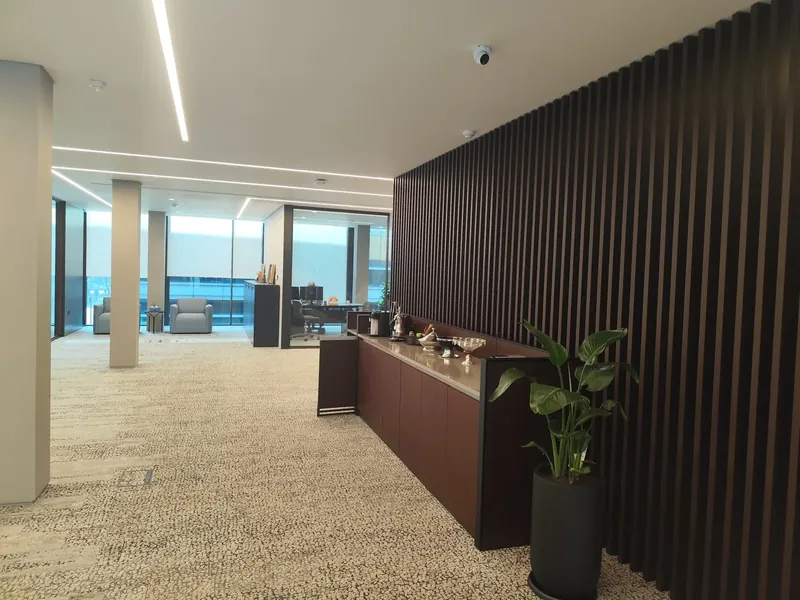

Also delivered: MOFA office renovation in Manama for Almoayyed, Bareeq Al Retaj office renovation at Moda Mall, and the Ajmal Perfumes regional office at Business Bay.
What clients ask us first.
What is the difference between Category A and Category B fit-out?
Category A brings a leased floor to a lettable standard — raised floors, suspended ceilings, base mechanical and electrical services, and blank perimeter walls. It is normally the landlord's scope. Category B is the occupier's own fit-out on top of that: partitions, meeting rooms, branding, joinery, IT infrastructure and furniture. A tenant taking a Category A floor is contracting for Category B works.
Can you work while our staff remain in the office?
Yes, and a large share of our office work is exactly that. We zone the floor so one area is under construction while the rest stays occupied, run noisy and dust-generating trades outside business hours, and keep fire escape routes compliant throughout. It takes longer overall than an empty floor and it needs a written phasing plan agreed before mobilisation, but it avoids the cost of decanting a business into temporary premises.
Which approvals does a commercial office fit-out need in Bahrain?
Typically Municipality clearance, Civil Defence approval covering the fire strategy, detection and escape routes, and EWA coordination for any change to electrical or water connections. Landlord or building management approval sits alongside these. We prepare and submit the drawings through approved consultants as part of our scope, because the sequence between them is where most fit-out programmes lose weeks.
Do you handle the design as well as the construction?
Yes. We work either from a consultant's design, where we take on buildability review, shop drawings and authority submissions, or on a design-and-build basis where we develop the layout and detailing ourselves. Design-and-build removes the gap where a designer and a contractor blame each other for a clash, because there is only one party accountable for both.
What happens after handover?
A twelve-month defects liability period covering workmanship, materials and installed systems, with manufacturer warranties passed through to you separately. You receive as-built drawings, equipment manuals, warranty certificates and a maintenance schedule as part of handover rather than on request afterwards.
Need this on your project?
Send us the drawings and the handover date and we will come back with a programme and a price.